
Subscribe to get access to exclusive offers from my author website https://danielbuckleyindiewriter.com
Look into the face of the Sun God Paiawon Apollo, the ancient deity of Music, Philosophy, truth, and light in an ancient world of darkness. From Eastern lands, his name spread with peoples who migrated from East to West, settling new lands on the islands of the sea the Egyptians called the Great Green.
Ancient Syria and Anatolia had settlements that worshipped male and female deities.
Co rulers of their worlds who shared power you can see this model in other repeated in many other religions and cultures the Minoans had the divine pair of deities the Mistress and Master of Animals hunting deities associated with their control over the wild animals and the Mountain landscapes they ruled over being ancient Hunter deities connected with the cultures of their ancient ancestors.
Greek culture had the twin deities of Apollo and Artemis.
Shared rule was a theme that settlers who migrated from the Eastern world delivered on the native populations they settled beside influencing the cult beliefs they followed and as they migrated around the Mediterranean world, they also exported their belief systems and culture across the ancient world.
They settled via three main migrations and each phase impacted the lands the islands and the people they settled beside.
From as early as 7,000 B.C settlers arrived on Crete they delivered their knowledge of tool making and new techniques of agriculture and farming that advanced and influenced the native populations to a new way of life and culture.
Settlements became villages and developed into towns and finally cities as the population of Crete expanded.
With the increase of food production and the storage of the resources improved this called for new roles and new jobs to be created as the society grew and expanded in size the production of food and other goods increased cr5eating surpluses that could be stored to be later shared and distributed with the cities people and citizens going forwards from the temple and palace sites storage areas located in the heart of the many Minoan cities and settlements.
Crete was during the Minoan time period densely populated with ancient writers stating that up to ninety cities once existed on the Mountainous and mysterious island protected by the seas their ships and sea captains had ruled and controlled and the lucrative sea trade routes they patrolled and policed.
The seafaring peoples called the Minoans named after the Legendary King Minos and Minos Kalokairinos the Cretan Antiquarian who first excavated the temple site back in 1878 at Knossos the ancient, settled palace and temple site near the modern-day capital of Heraklion on Crete.
What developed was an island based seafaring empire it was the sea trade routes that delivered the prosperity on the back of their fleets and the sea captains the Minoans produced that delivered their control over the high seas and the wealth and riches that delivered to the Minoans and the growing elites and city states prospered and expanded creating a unique culture that expressed its way of life with the artifacts and finished ceramics an pottery they produced added to the style in which they dressed themselves and the jewellery they produced in the many specialist workshops the craftsman had set up on the varied temple sites towns and cities that existed on Crete and around the sea based empire the Minoans ruled.
Minoan art and identity fired the culture of the Minoan world and inspired its people’s creativity as they continued to produce goods that were in demand around the ancient world.
Legends of Minos are known along with the deities that represented the youthful aspect of their ancient deities it was a bout the vitality of life be that in the colours they used to decorate their temples walls their temples rooms and sacred spaces such as the pillar crypts that existed at Knossos and no doubt other Minoan palace and temple sites on Crete.
Their vivid frescoes with their complex imagery and movement and life captured in the movement of the figures involved in the scenes of ritual activities surrounding the varied bull games held in the most sacred central squares in the heart of the palace and temple centres.
Acrobats performed the death-defying bull leaping before grandstands filled with spectators taking in the bull games and the boxing contests that saw fighters entertain the crowds before the main bull games commenced.
Each of the Minoans sacred realms are reflected in their vibrant colours Heaven – Blue Earth -Yellow and Underworld – Red.
Within their frescoes they display their cultures vibrancy, and the celebration of movement nature and movement are captured as are cult ritual scenes and ritual activity such as the bull games their deities are also captured in the frescoes with the priests and priestesses and handmaidens all dressed in their ceremonial robes and dress worn to attend the varied festivals to honour the Minoan deities.
In the Minoan world the youthful deity was always depicted as a vibrant powerful tall athletic figure with muscled legs and arms and powerfully built broad shoulders.
Known by the name of the Master of Animals Paiawon-Apollo an ancient Eastern deity the hunter gatherer world and culture a deity that like is twin deity Artemis transferred over from the East to the West was worshipped on Minoan Crete and in the later Mycenean world and in Greek religion as Apollo such was his power Apollo later became the only Greek deity to cross over into the Roman world and culture and retained the name Apollo.
Today the sacred sites of Apollo are located around the Greek world most notably at Delphi and Delos that promote the glorious past of the deity his followers would make the long pilgrimages from around the Greek speaking world to gain an audience with the mouthpiece of the deity the Pythia the goddess who the deity used to communicate with his followers who gave up offerings and sacrificed gift’s in exchange for an audience with the Sun and Archer deity of music, philosophy and the master of Animals.
Alexander the Great and his father Philip of Macedon were both loyal followers of the deity Apollo and both had a deep hatred for the city state of Thebes due to them backing the Persian forces that invaded Greece, during the campaign they attacked the sacred site of Delphi on mount Parnassus an act that would see the patriotic Macedonians seek retribution on both Thebes and Persia.
Having sworn to avenge the treachery of the Thebans and punish the people and the city of Thebes.
When on campaign fighting in the sacred wars on the side of his deity Apollo Alexander the great conquered the city state of Thebes and raised all the houses to the ground sparing only one house that of the poet Pindar who was connected with the sacred site of Apollo at Delphi and like many of his family members had served as a priest of Apollo on the temple site at Delphi.
Pindar produced Paeans for the Greek city states in honour of the deity Apollo.
Many of the earliest Greek philosophers were Ionian Greeks born in the Greek city states on the coastline of Turkey.
Philosophers such as Pythagoras and Xenophanes who travelled the ancient world visiting Italy and Sicily promoting and creating philosophical debate and theory to their followers and the world in general both were followers of Apollo.
Xenophanes penned a vivid poem for a Greek traditional drinking party see below.
” Now the floors are clean, and the cups are in the hands of all, and someone puts wreaths woven of flowers on our heads and another offers fragrant perfume in a flask, and the mixing bowl stands there full of delight and there is another wine ready in the jars, sweet and smelling of flowers which says it will never betray us.
In the midst incense send up its holy scent, and there is water sweet and clear.
Golden brown leaves are ready, and a table loaded with cheese and sweet honey.
There is an altar in the middle of the room, all decked with flowers and singing and joy all around the house.
Men of sense ought first to sing the god’s praises, with reverent stories and pure speech.
When we have poured libations and prayed that we may be able to do right.
There is no harm in drinking as much as one can get home without the guide if one isn’t extremely old.”
XENOPHANES PENNED CIRCA 500 B.C.
Xenophanes believed in a supreme divine power or entity stable and capable of action through thought for Xenophanes this entity is unlike mortals in body or thoughts.
Timeless the soul is eternal AION.
Pythagoras was associated with the deity Apollo
The first Greek thinker to contemplate the divine ordered beauty of the Cosmos the essence of objects their mathematical order beyond just matter itself.
Poets and Philosophers felt closer to Apollo and inspired by the god who represented speech song movement and music above all other deities his influence from the beginning of time continues today with his association with the sacred oracular sites all over the Greek speaking world that today still attract visitors from all corners of the civilized world.
Apollo was associated with Healing, well-being and morality and as such he was called as a witness by Socrates at his trial for alleged crimes against the city state of Athens.
Socrates was accused of corrupting the minds of the youths of Athens.
He had served the city state of Athens as a hoplite warrior during the Peloponnesian war from 431 down to 404 B.C.
Socrates also saw the building of the Parthenon that commenced in 447 B.C. during the reign of Pericles.
Calling Apollo as a witness at his trial was a risk for Socrates as many Athenians feared the deity and viewed Apollo as an enemy of Athens.
Apollo had backed Sparta in the Peloponnesian war and sent the plague that had decimated the city and ended the life of Pericles.
Socrates after serving the state all his life loyally was put on trial for his alleged crimes at the age of seventy.
He asked all Athenians to examine their lives and take care of their souls.
His followers enjoyed his philosophical debates and teachings held in the Agora and other public places.
He challenged the morale complacency and wisdom of many ruling elites.
Apollo was the spiritual heart of Greek culture he spoke from the centre of the world through the ” Pythia.”
” There is a higher life than the human level not in virtue of his humanity will a man achieve it, but in virtue of something within him that is divine.” Plato stated.
Apollo had with Socrates a follower who was prepared to sacrifice himself rather than denounce his deity and his philosophical mission but his acceptance of the verdict of the state of Athens also meant he remained faithful to the city of Athens.
Condemned to death by the city state he loved he died a hero who went willingly to his fate true to his moral principles he nourished his soul.
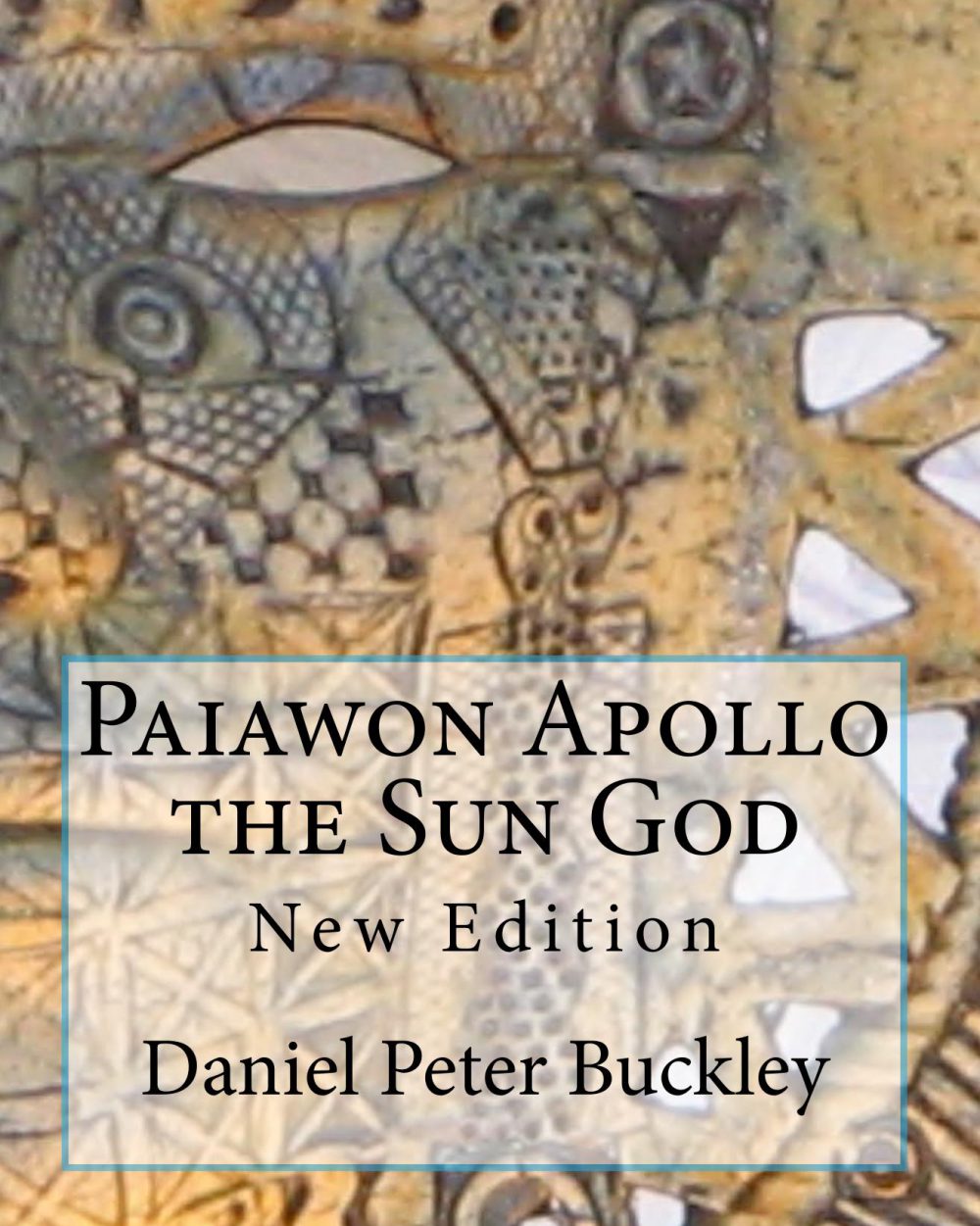
POHTO BY DANIEL BUCKLEY OF THE SUN GOD MASK ” SUNBURST.”
BY ARTIST ALASDAIR MACDONNEL BATH – UK.
ALL OTHER MEDIA PROVIDED BY DANIEL BUCKLEY AND PENNED BY DANIEL BUCKLEY.
Original version first posted September 25th, 2011, THANKS FOR READING THE NEW VERSION PENNED NOVEMBER 6TH 2023

 THE HISTORY WRITER .NET
Leave a comment